Description
There is tungsten added in the grade to resist pitting corrosion and the molybdenum content resists other localized corrosion attacks. A very small quantity of vanadium is added to impart the required hardness. Other alloying elements make sure the grade is machinable and retains its mechanical properties at sufficient temperatures.
It is a solid-phase solution alloy, which naturally makes it durable. Being a nickel compound, the alloy generally resists various chemicals, promotes toughness, and provides general corrosion resistance. Hastelloy C276 is one of the rare alloys that resist wet chloride gas, chlorine dioxide and, hypochlorite solutions. It gives great resistance to chloride stress corrosion cracking and other chloride solutions. When tested for cracking under 45% boiling magnesium chloride, the grade 316L took 2 hours to crack, the grade 254SMO took 24 hours to crack, and the Hastelloy C276 took 1000 hours to crack. The microstructure of the alloy gives it great welding, forming, and machinability. The low carbon content makes the alloy resistant to intergranular corrosion at the heat-affected zones. The grade got into applications to ease the concerns over welding. The low carbon content restricts the formation of carbides at the grain boundaries.
The alloy also has considerable impact strength — a 10mm thickness plate could withstand 470J at room temperature under the Charpy v-notch test. Hence, its uses in dynamic applications. The alloy can be conveniently extruded, hot-worked, and cold-worked. The alloy might tend to work hard. At elevated temperatures – strain age cracking problem, common with other strengthened alloys is avoided in this alloy. Hot working can be suitably done around 880-1240°C while heavier sections can be heated to a minimum of 1100°C before forming. The alloy shows its versatility in various conditions and can be conveniently processed and used in many applications.
Chemical Properties
CHEMICAL PROPERTIES
| Grade | Ni | C | Co | Mn | Si | Cr | W | S | V | Fe | P | Mo | |
| Hastelloy C276 | Min. | Bal(50.99) | – | – | – | – | 14.5 | 3.0 | – | – | 4.0 | – | 15.0 |
| Max. | – | 0.010 | 2.5 | 1.00 | 0.08 | 16.5 | 4.5 | – | 3.5 | 7.0 | 0.04 | 17.0 |
Physical Properties
| Density | 8.89 g/cm 3 / 0.321 lb/in 3 |
| Melting Point | 1325 -1370 (°C) / 2415 – 2500 (°F) |
| Specific Heat @ 70°F | 0.102 BTU/lb-°F @ 70°F 427 J/kg-°C @ 20°C |
| Thermal Conductivity @ 70°F | 67.9 BTU-in/ ft2-hr-°F 9.8 W/m-°C |
| Young’s modulus 103ksi | 29.8 |
| Shear modulus 103ksi | 11.4 |
| Electrical resistivity | 51 Microhm-in at 75°F 1.30 Microhm-cm at 24°C |
| Permeability at 200 oersted (15.9 ka/m) | 1.0002 |
| Annealing | 1121 (°C) / 2050 (°F) |
| Quench | Rapid Air |
| Poisson’s ratio | 0.307 |
General Data
| Standard | C276 |
| UNS | N10276 |
| WERKSTOFF NR. | 2.4819 |
| EN | NiMo16Cr15W |
| BS | – |
| GOST | ХН65МВУ |
| JIS | NW 0276 |
| AFNOR | NFE30C20DUM |
| OR | ЭП760 |
Standards Specifications
PIPES & TUBES
| Summary | Standards |
| Standard Specification for Welded Nickel and Nickel-Cobalt Alloy Pipe | ASTM B619 |
| Standard Specification for Seamless Nickel and Nickel-Cobalt Alloy Pipe and Tube | ASTM B622 |
| Standard Specification for Welded Nickel and Nickel-Cobalt Alloy Tube | ASTM B626 |
| Standard Specification for Electric Fusion Welded Nickel and Nickel Alloy Pipe | ASTM B474 |
FITTINGS & FLANGES
| Summary | Standards |
| Standard Specification for Factory-Made Wrought Nickel and Nickel Alloy Fittings | ASTM B366 |
| Standard Specification for Nickel Alloy Forgings | ASTM B564 |
Forms of Supply
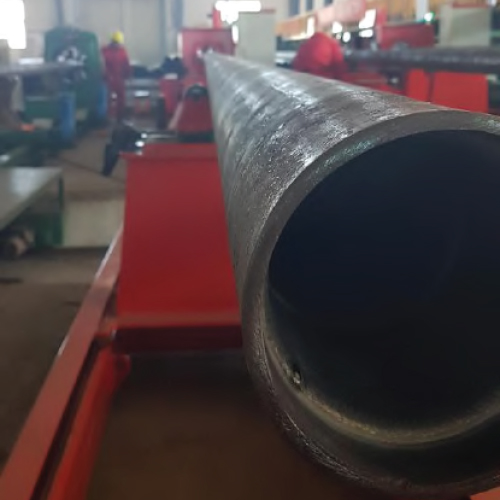
Piping and tubing, fittings and flanges, washers.
Corrosion Resistance
Hastelloy C276 is a superalloy with exceptional properties in resistance to corrosion and chemical environments. The nickel in the alloy is resistant to various media and resists corrosion in active state as well as aggressive acidic conditions. Pertaining to a good amount of chromium and molybdenum content, oxidizing as well as non-oxidizing acids are also restricted. Resistance to localized corrosion like pitting and crevice corrosion is reasonably obtained. The addition of tungsten helps in the process.
A wide range of chemical environments like ferric and cupric oxide, many chloride solutions like sulphuric acid, hydrochloric acid, acid chlorides, acetic acid, formic acid, acetic anhydride, wet chloride gas, hot contaminated mineral acid, and, phosphoric acid with concentration under 65%, can be suitably resisted. The alloy also shows resistance to sulfide stress corrosion cracking as well as cracking in oilfield environments. The grade restricts intergranular corrosion at the grain boundary due to the low carbon content. Hence, it can be used readily with fine corrosion resistance without post-weld heat treatment. Most of the oxidizing salts are also resisted by the alloy.
Heat Treatment
Annealing of the grade needs to be carried out after the forming and working processes around 1120-1180°C, followed by a rapid quench. Soaking for appropriate time per section should be carried out. Quenching shall be done in a protective atmosphere. Cold working might slightly affect the stress corrosion cracking resistance and hence annealing of the cold-worked part should be carried out. Since the alloy work hardens rapidly, cold working with intermediate annealing might be required.
Weldability
The alloy is readily used in weld conditions since the intergranular corrosion at the heat-affected zone of the weld is resisted. However, excessive heat input should be avoided. Welding processes like gas tungsten arc, shielded metal arc, and gas metal arc welding can be suitably used. Filler metals of matching grades can be used.
Machining
The fine microstructure of the alloy gives it great machining characteristics. However, due to work hardening, high heat might be generated during cutting. Machining features like high-power machinery, tools as well as workpiece rigidity, correct rake angles, and adequate lubrication should be taken care of.
Applications
Forgings, Fasteners, Industrial and municipal waste treatment, Flue gas desulfurization systems, Pharmaceutical and food processing equipment, Air pollution control, heat exchangers, reaction vessels, evaporators, transfer piping, Sour gas wells, Pickling baths, Pulp and paper production, Sulfuric acid reactors, Plastic production, Equipment for processes utilizing halide or acid catalyst, Organic chloride process equipment, Digesters and bleach plants in the paper industry.
Possible grade alternatives
INCONEL 625
| Grade | Ni | C | Tl | Mn | Si | Al | Cr | S | P | Nb+ta | Co | Mo | Fe | |
| Inconel 625 | Min. | 58.00 | – | – | – | – | – | 20.00 | – | – | 3.15 | – | 8.00 | – |
| Max. | – | 0.10 | 0.40 | 0.50 | 0.50 | 1.70 | 23.00 | 0.015 | 0.015 | 4.15 | 1.00 | 10.00 | 5.00 |