Description
Nickel alloy maintains a balance in the composition of other alloying elements so as to obtain optimum properties. Both the alloys are solid solution strengthened, and hence the strength of both the pure metals is exceptional. Both the grades have similar chemical composition except for their carbon content.
Hence, grade 201 is used for applications at elevated temperatures since its lower carbon content will restrict embrittlement due to graphitization or carbide precipitation. In the range of 430- 650°C, the use of Nickel 200 is not recommended since it might lose its ductility due to the carbide precipitation. In annealed conditions, they have an approximate strength of mild steel, while in rolled conditions, they have better strength. Both the grades are ferromagnetic by nature. The specific properties of Nickel 200 include high thermal as well as electrical conductivity, low gaseous constituents, low electrical resistivity, and appropriate magnetic properties.
The thermal conductivity of Nickel 200 is 487 Btu. in/ft^2. h.°F (British thermal unit). The torsional strength of the grade in breaking strength of 1” dia rod is 558 MPa, which is quite competent. Hence it could be used in dynamic applications as required. The grade is one of the toughest with respect to impact strength properties due to its nickel content. During the Izod test, the alloy can absorb 163J of energy and during the Charpy v-notch test, it can absorb 271J in impact. As per Charpy tests, Nickel 200 stands as the most durable alloy in regard to impact properties. The grade also has brilliant properties in stress fatigue cycles.
The grade in cold worked conditions will endure 10^6 cycles in freshwater with 386MPa maximum stress, in seawater, it will be 372MPa, and in air, it will be 434MPa. The grade 200 forms a protective passive layer in the presence of an oxidizing environment and, hence is used in respective applications. The resistance to caustics by the grade is due to the presence of this layer. The Nickel grade 201 has a lower work hardening rate and is suitably used for cold-working operations. Both the grades can be considerably hot and formed to almost every shape with proper end temperature. The strength of the grade can be significantly increased with cold-working processes.
Chemical Properties
CHEMICAL PROPERTIES
| Grade | Ni | C | Mn | Si | CU | Cr | Fe | S | |
| Nickel 200 | Min. | 99 | – | – | – | – | – | – | – |
| Max. | – | 0.15 | 1 | 0.035 | 0.25 | – | 0.40 | 0.01 |
Physical Properties
| Density | 8.89 g/cm 3 / 0.321 lb/in 3 |
| Melting Point | 1435 – 1446 (°C) / 2615 – 2635 (°F) |
| Specific Heat @ 70°F | 0.109 Btu/lb•°F |
| Thermal Conductivity @ 70°F | 487 Btu•in/ft2•h•°F |
| Young’s Modulus @78°F | 29.7 x 10⁶ psi |
| Electrical resistivity @ 70°F | 58 μΩ•m |
| Annealed | 900 – 928 (°C) / 1650 – 1700 (°F) |
| Quench | Rapid Air/Water |
General Data
| Standard | Nickel 200 | Nickel 201 |
| UNS | N02200 | N02201 |
| WERKSTOFF NR. | 2.4066 | 2.4068 |
| EN | Ni 99.2 | LC-Ni 99 |
| BS | NA 11 | NA 12 |
| GOST | НП-2 | НП-2 |
| JIS | NW 2200 | NW 2201 |
| AFNOR | N-100M | – |
Standards Specifications
PIPES & TUBES
| Summary | Standards |
| Standard Specification for Nickel Seamless Pipe and Tube | ASTM B161 |
| Standard Specification for Electric Fusion Welded Nickel and Nickel Alloy Pipe | ASTM B474 |
| Standard Specification for Seamless Nickel and Nickel Alloy Condenser and Heat-Exchanger Tubes | ASTM B163 |
| Standard Specification for Welded Nickel (UNS N02200/UNS N02201) and Nickel Copper Alloy (UNS N04400) Pipe | ASTM B725 |
| Standard Specification for Welded Nickel (UNS N02200/UNS N02201) and Nickel Copper Alloy (UNS N04400) Tube | ASTM B730 |
FITTINGS & FLANGES
| Summary | Standards |
| Standard Specification for Factory-Made Wrought Nickel and Nickel Alloy Fittings | ASTM B366 |
| Standard Specification for Nickel Alloy Forgings | ASTM B564 |
Forms of Supply
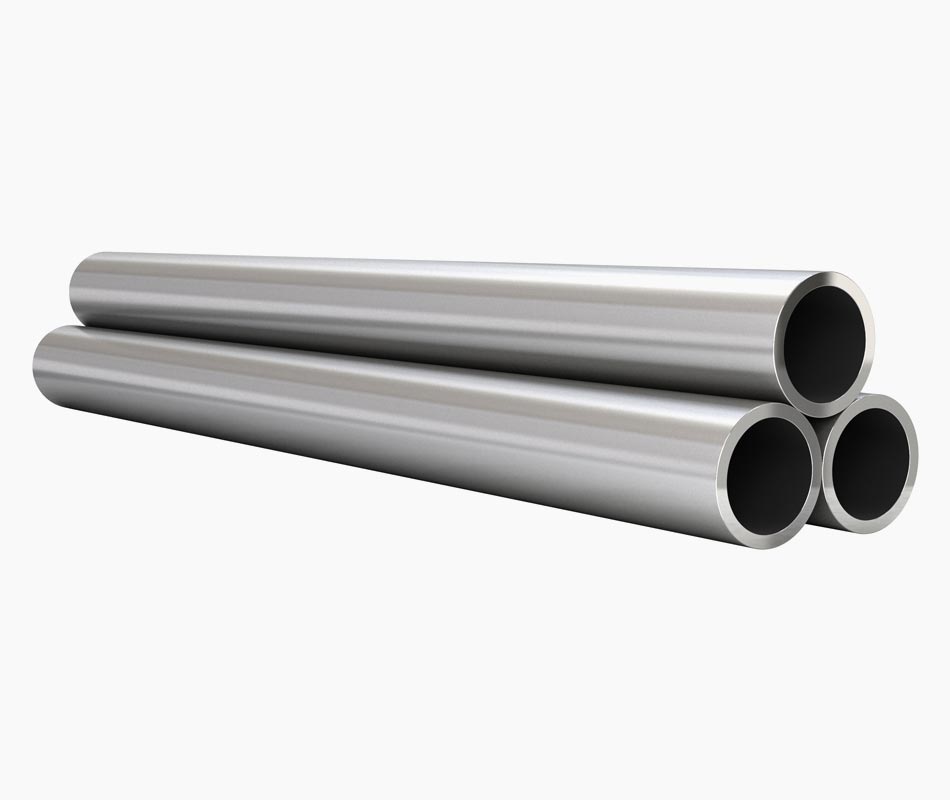
Piping and tubing, fittings and flanges, washers.
Corrosion Resistance
The grade is most useful in reducing environments. It shows considerable corrosion resistance in the presence of caustic alkalis, neutral alkalis as well and high oxidizing environments. Nickel 201 can resist a temperature range of 320-750°C for extended times without losing its properties.
It is used in laboratory equipment that needs to withstand oxidizing temperatures of about 1100°C. Both grades can suitably resist aqueous corrosion. In the presence of caustic soda (NaOH) at 90°C is 0.5 mph (mils per year) and at 120°C is 1 mph. In the presence of 10% HCl at 30°C, the corrosion rate is 80 mph. The grade does not perform well in the presence of nitric acid.
Heat Treatment
Both the grades can be annealed by carefully selecting the temperature range. It can be done around 700-880°C. The time in temperature should be taken care of along with sectional annealing for maximum strength and mechanical properties. Grade 201 has lower carbon content and a lesser hardening rate.
Weldability
The grade can be welded by conventional techniques such as SAW, SMAW, TIG, etc. Grade 201 has better welding properties due to lesser carbide precipitation at the heat-affected zone.
Machining
The grade can be suitably machined at a commercial rate with a common technique. HSS (high-speed steel) and cast alloy tools are commonly used. The grade while machining tends to form long stringy chips. Proper speeds and rigid tooling will be required to avoid the same.
Applications
Food production, Manufacture and handling of sodium hydroxide, Storage vessels, Valves, Mixers, Viscose Rayon manufacturing, Reactors and vessels, Production of hydrochloric acid and chlorination of hydrocarbons such as benzene, methane and ethane, Shell plate, Tank heads, Heat exchangers, Fluorine generation, Synthetic fibers, Rocket motors, Aerospace and missile components, Drums to transport chemicals, Handling of foods.
Possible Grade Alternatives
INCONEL 600
| Grade | Ni | C | Mn | Si | CU | Cr | Fe | S | |
| Inconol 600 | Min. | 72 | – | – | – | – | 14.0 | 6.0 | – |
| Max. | – | 0.15 | 1.00 | 0.50 | 0.50 | 17.0 | 10.0 | 0.015 |