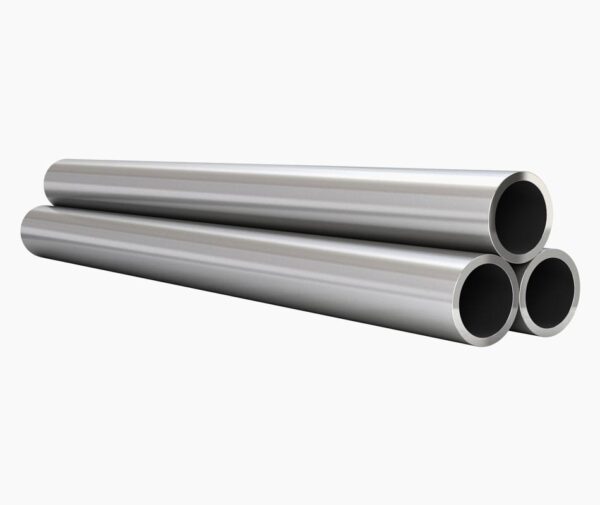
Description
The grade can provide double the strength of the 3300 series under normal conditions. Normally, it has PREN (pitting resistance number) of about 43-44, which is fine enough to be used in environments having high pitting. But with it, it also provides fine crevice corrosion resistance.
The grade is normally delivered in an annealed condition that yields stress of about 300MPa. The yield stress provided by the grade is very low compared to duplex steels and even lower when compared to super duplex stainless steels. The grade is not used at very high temperatures but it can be used in variable industrial conditions. Ductile to brittle transition in lower temperatures is zero to none whilst the notch ductility provided by the grade is exceptional, even at sub-zero temperatures. Due to its low carbon content, intergranular corrosion is highly avoided. Carbide precipitation at the grain boundary of the heat-affected zone during processes like welding is restricted. This grade can be machined conveniently and has its application in various forms and shapes.
It has a low magnetic permeability in the annealed condition, which might change after welding. It also has high impact strength at room temperature and conveniently retains its strength at sub-zero temperatures. It can be suitably worked under proper conditions. 31254 is also known to be cost-effective and possibly used as an alternative for high-cost titanium and nickel alloys providing similar characteristics. The grade can be appropriately hot worked as well as cold worked, forging and hot working operations are usually performed at a temperature of 980-1150°C. During these processes, the temperatures should be balanced properly, since higher temperatures would result in the reduction of toughness and ductility of the material. The grade can be hardened by a proper cold reduction process.
Chemical Properties
CHEMICAL PROPERTIES
| Grade | Ni | C | CR | Mn | Si | P | Fe | S | Mo | N | |
| Duplex SS 31254 | Min | 17.5 | – | 19.5 | – | – | – | Bal | – | 6.0 | 0.18 |
| Max | 18.5 | 0.02 | 20.5 | 1.00 | 0.08 | 0.03 | – | 0.01 | 6.5 | 0.22 |
Physical Properties
| Density (kg/cm3) | 8 g/cm3 0.289 lb/in3 |
| Melting Point | – |
| Specific Heat 0-100°C ( J/kg.K) | 500 J.kg-1.°K-1 |
| Thermal Conductivity at 20°C Btu/h ft ºF | 14 W/mK 97.2 BTU in/hr.ft².°F |
| Elastic Modulus (GPa) | 195 Gpa 28300 Ksi |
| Electrical resistivity [μΩ. cm] | 8.5 μohm/cm |
| Poissons Ratio | 0.30 |
| Shear Modulus | 75 Gpa 10900 Ksi |
General Data
| Standard | 31254 |
| UNS | S31254 |
| WERKSTOFF NR. | 1.4547 |
| EN | X1CrNiMoN20-18-7 |
| US | ASTM A479/A473, /A240 S31254 F44 |
| AFNOR | |
| JIS |
Standards Specifications
PIPES & TUBES
| Summary | Standards |
| Standard Specification for Seamless Ferritic and Austenitic Alloy-Steel Boiler, Superheater, and Heat-Exchanger Tubes | ASTM A213 |
| Standard Specification for Welded Austenitic Steel Boiler, Superheater, Heat-Exchanger, and Condenser Tubes | ASTM A249 |
| Standard Specification for Seamless and Welded Austenitic Stainless Steel Tubing for General Service | ASTM A269 |
| Standard Specification for Seamless, Welded, and Heavily Cold Worked Austenitic Stainless Steel Pipes | ASTM A312 |
| Standard Specification for Electric-Fusion-Welded Austenitic Chromium-Nickel Stainless Steel Pipe for High-Temperature Service and General Applications | ASTM A358 |
| Standard Specification for Welded Large Diameter Austenitic Steel Pipe for Corrosive or High-Temperature Service | ASTM A409 |
FITTINGS & FLANGES
| Summary | Standards |
| Standard Specification for Forged or Rolled Alloy and Stainless Steel Pipe Flanges, Forged Fittings, and Valves and Parts for High-Temperature Service | ASTM A182 |
| Standard Specification for Wrought Austenitic Stainless Steel Piping Fittings | ASTM A403 |
Forms of Supply
Piping and tubing, fittings and flanges, washers.
Corrosion Resistance
The high molybdenum content of the grade combined with nickel, nitrogen, and copper gives excellent resistance to various forms of corrosion, especially to pitting corrosion. Hence giving its usage in many applications. Resistance to moderate and concentrated halide-containing environments is provided like chloride, bromide, fluoride, etc. Excellent resistance to stress corrosion cracking and good resistance to erosion cracking is provided. Due to the very low carbon content in the grade, intergranular corrosion due to carbide precipitation is also avoided.
Heat Treatment
The grade is non-hardenable by heat treatment and hardness is possibly increased by cold working on the grade. Annealing is normally performed on the grade after various working processes to restore its ductility, improve its corrosion resistance, and remove internal stresses. It is done around 1150-1200°C, followed by water quench. All the sections are thoroughly soaked at an appropriate time at temperature.
Weldability
The grade has fine weldability features and can be welded with various techniques. Pre-heating is normally not done and if welded by proper technique, post-weld heating is also not required. Since the grade does not have very good thermal properties – with high thermal expansion and low thermal conductivity, the distortion at the weld due to expansion is properly controlled. The grade should not be welded without filler metals or it would lose its original strength.
Machining
The grade has a high work hardening rate along with superior strength. Hence, machining on the grade becomes a little difficult. Also, there is a lack of sulfur content. Use of sharp and rigid tooling, powerful machinery, positive feeds, adequate lubrication, and slow speeds are recommended.
Applications
Paper and pulp, Flue gas desulphurization units in power plants, Desalination plant equipment, Pipework, flanges & manifolds, Seawater handling systems, Oil and gas industry components, Pumps, Chemical processing, Valves, Control, and instrumentation tubes, Process equipment in chemical industry, Components used in petroleum production, Tall oil distillation columns, Saltwater handling, Food processing equipment.
Possible Grade Alternatives
GRADE 254 SMO
| Grade | C | Cr | Mo | N | P | Cu | Mn | S | Ni | Fe | Si | |
| 254 SMO | Min. | – | 24 | 3 | 0.24 | – | – | – | – | 6 | Bal | – |
| Max. | 0.030 | 26 | 5 | 0.32 | 0.035 | 0.50 | 1.20 | 0.020 | 8 | – | 0.80 |
GRADE HASTELLOY C276
| Grade | Ni | C | Co | Mn | Si | Cr | W | S | V | Fe | P | Mo | |
| Hastelloy C276 | Min. | Bal(50.99) | – | – | – | – | 14.5 | 3.0 | – | – | 4.0 | – | 15.0 |
| Max. | – | 0.010 | 2.5 | 1.00 | 0.08 | 16.5 | 4.5 | – | 0.35 | 7.0 | 0.04 | 17.0 |